
Home · Crystals & Stones · Obsidian Mani Mantra
Obsidian Mani Mantra — Oṃ Maṇi Padme Hūṃ

Obsidian Mani Mantra
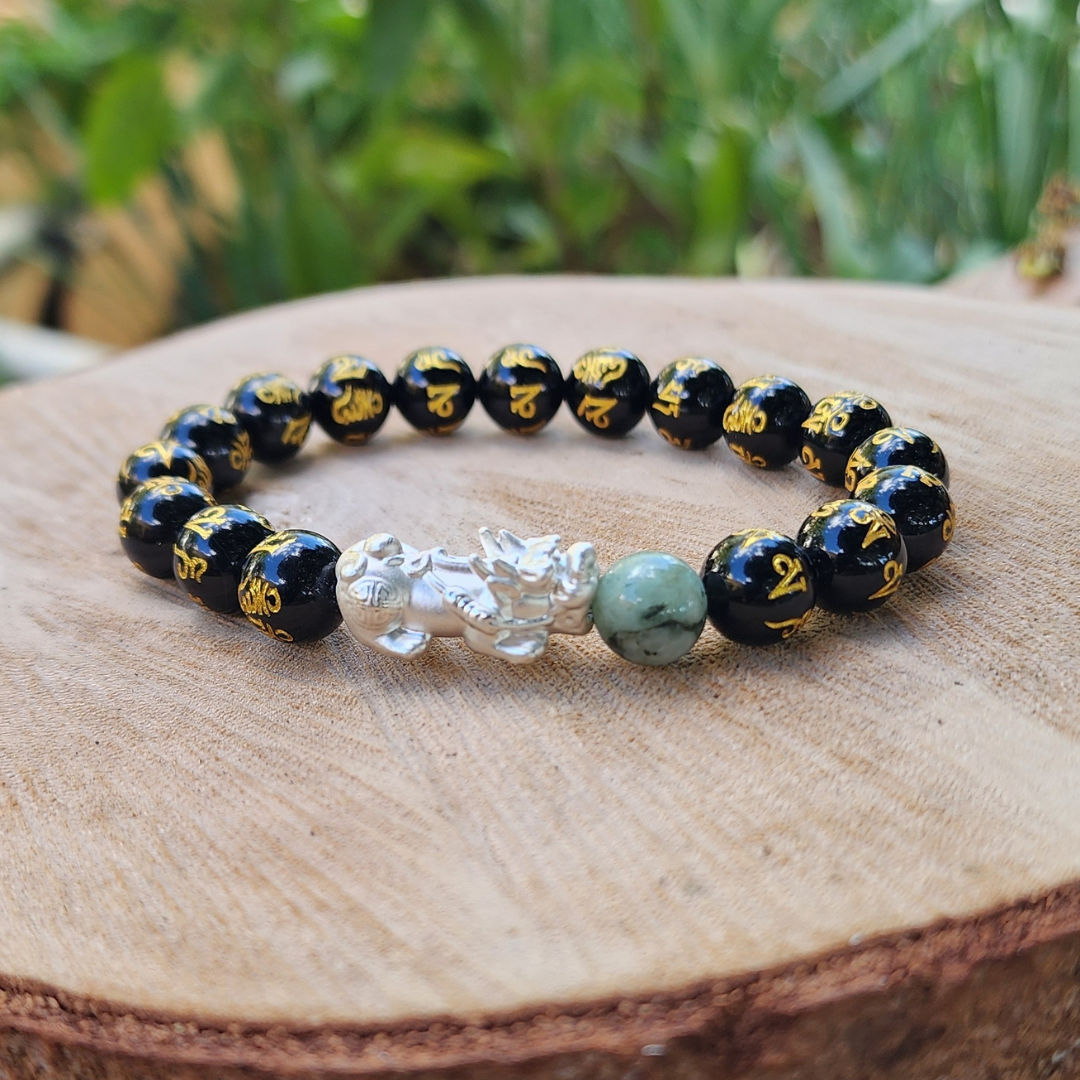
Black volcanic glass hand-carved with the six-syllable mantra of universal compassion — Oṃ Maṇi Padme Hūṃ.
Physical Characteristics
Associations
Healing Properties
- Compassion practice
- Silent mantra recitation
- Spiritual protection
- Purification of negative qualities
- Bodhicitta cultivation
- Refuge & remembrance
Colour
About Obsidian Mani Mantra
The Mani mantra invokes Avalokiteśvara (Tibetan: Chenrezig; Chinese: Guanyin), the bodhisattva of universal compassion. His Holiness the 14th Dalai Lama has cautioned that the mantra cannot be reduced to a single English sentence — popular renderings like "the jewel is in the lotus" miss its depth. Each syllable is itself a complete teaching, and together they trace the entire Mahāyāna path of awakening.
The bead pairs the mantra with black obsidian — the dense volcanic glass that tradition treats as the most absorbing of all natural materials. The pairing is intentional: obsidian's transmuting nature reinforces the mantra's purifying function. Worn in silent recitation, traced with the thumb across the wrist mala-style, or simply kept close as a tangible refuge — the carved syllables visible in gold against the deep black face of the stone.
History
The Mani mantra has been recited in Tibetan Buddhism for over a millennium, invoking Avalokiteśvara (Chenrezig in Tibetan, Guanyin in Chinese), the bodhisattva of compassion. Carving the mantra onto stones, prayer wheels, and obsidian beads is an ancient devotional practice — the mantra's power is held to extend through every object that bears it. The pairing with obsidian draws on the volcanic glass's traditional reputation as the most absorbing and transmuting of natural materials.